Solitaire Associations Journey
- 4.4
- Rating
- 10.00M
- Installs
- Free
- Price
 Analysis by App-foxy
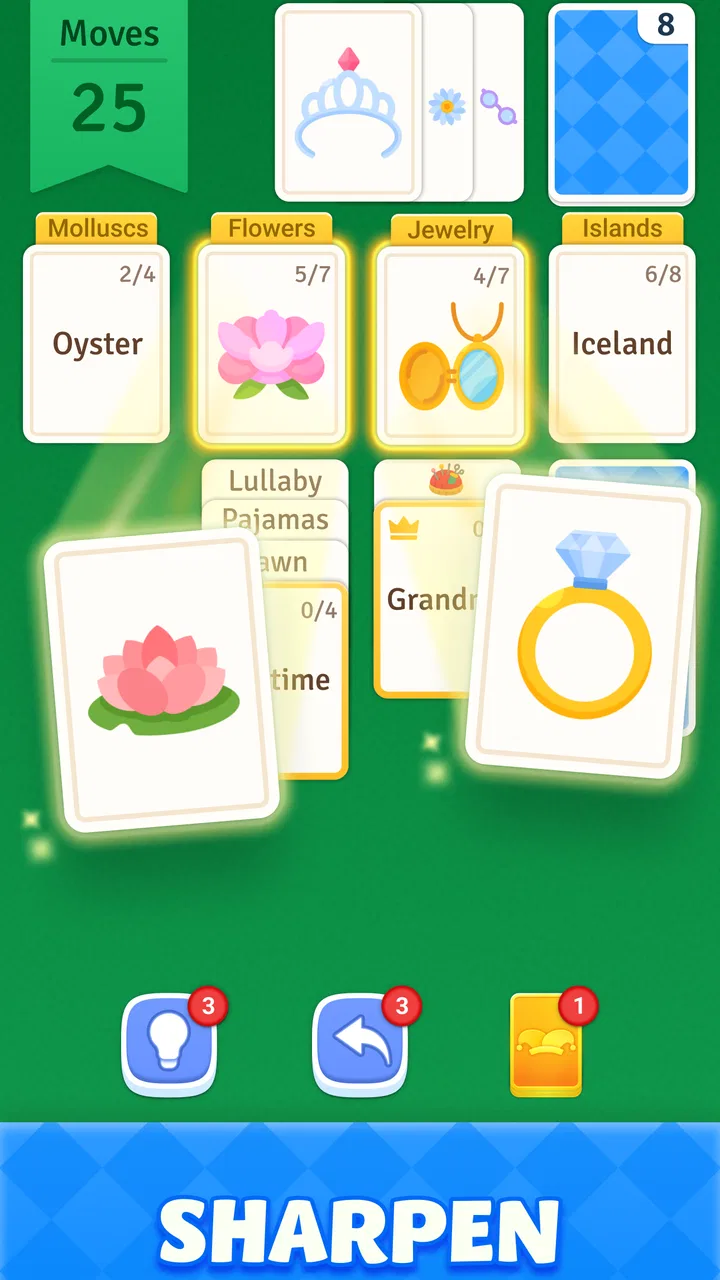
Solitaire Associations Journey takes the familiar calm of solitaire and replaces cards with words that must be grouped by meaning. After spending time with it, I found its main appeal easy to understand: it is a quiet word game for short sessions, but it still asks me to notice relationships, question my first assumptions, and make careful choices. It is not a traditional card solitaire game, and it is not a fast vocabulary quiz. Its identity sits somewhere between a category puzzle and a gentle daily brain exercise.
That distinction matters before you download it. If you want a game with dramatic progression, competitive matches, or a deep story, this will probably feel too modest. If you enjoy sorting ideas, spotting connections, and solving puzzles without pressure, it has a much better chance of becoming a regular companion. My overall view is positive, with one important reservation: the experience depends heavily on whether the category logic feels fair to you from puzzle to puzzle.
How the word-sorting idea works in practice
The central task is simple to explain. I am presented with words and need to arrange them into related groups, turning a familiar solitaire-style format into a test of association. The challenge is not merely recognizing a word; it is deciding which relationship is intended when several answers seem plausible. That small layer of uncertainty gives the game more personality than a basic matching exercise.
You May Also Like

 Blood Strike: 2.5 Anniversary
Blood Strike’s Loadouts Turn Every Drop Into a Tactical Gamble
A close look at Blood Strike’s custom loadouts: how fast access to signature weapons reshapes its battle royale rhythm, rewards preparation, and narrows the gap between fights.

 Pandora - Music & Podcasts
Pandora’s Music Is Easy to Start, but Harder to Recover
Pandora’s strength is its low-effort path from a seed to a station. Its weak spot is how much confidence it asks you to place in connection, setup, and quiet recovery.

 8 Ball Pool
 Is Built on Rivalries, Rematches, and Routine
A close look at the rivalries, rematches, shared routines, and unanswered safety questions that turn a quick pool match into a persistent mobile community.

 Samsung Music
’s Quiet Strength Is Playing What You Already Own
Its reach comes less from spectacle than from dependable access to a personal library. That simplicity is both the app’s strongest retention engine and its ceiling.

 AccuWeather: Weather Radar
AccuWeather Review: A Quick, Clear Forecast for Everyday Decisions
For everyday plans, the best forecast is the one you can understand quickly. AccuWeather makes rain timing, radar, and local conditions easy to act on, with a few trade-offs.

 Hill Climb Racing
Why Hill Climb Racing Still Turns Crashes Into One More Run
A tiny car, a bumpy hill and one more upgrade: Hill Climb Racing keeps resurfacing because its simple chaos makes every near-miss feel personal.
More From Our News Desk
View All News


In my experience, the best moments come when a group suddenly makes sense after looking wrong at first. A word may fit one obvious theme, while another word quietly belongs there for a less direct reason. The pleasure comes from moving beyond surface meaning and testing the whole set together. This makes each puzzle feel more like untangling a compact logic problem than simply recalling definitions.
The relaxing presentation suggested by the game’s concept also suits the task. I can approach a round slowly, pause to reconsider a group, and return to the remaining words without needing quick reflexes. That makes it a useful choice for a short break, a quiet evening, or a few minutes when I want something interactive but not emotionally demanding.
There is also a useful mental habit hidden in the design: I learned to avoid committing to the first connection that looked convincing. A practical approach is to identify the most certain pair or cluster, then leave ambiguous words aside until the board gives more context. This is more effective than trying to solve every group independently, because the remaining words often reveal whether an early theory was too broad.
That workflow is one of the game’s less obvious strengths. It rewards restraint rather than speed. Players who normally rush through word games may find that deliberately postponing a tempting answer leads to fewer mistakes and a clearer solution. I also found it helpful to ask what kind of relationship a group was using—meaning, usage, theme, or association—instead of assuming every group followed the same pattern.
For an app in the word category, that gives it a more thoughtful rhythm than a standard anagram or spelling game. Anagram games usually test letter manipulation, while crossword-style apps depend on clues and intersecting answers. This game focuses on the space between words: how they relate, how categories overlap, and how a set becomes comprehensible when viewed as a whole.
A strong fit for small pockets of time
The format works particularly well when I only have a few minutes. Imagine waiting for a friend at a café or taking a short break between tasks. A puzzle can give that moment enough structure to feel satisfying without requiring a long uninterrupted session. I do not need to remember a story, manage a character, or prepare for a match. I can simply open the game, think through a set of words, and stop when I am ready.
That convenience also makes it approachable for people who do not usually play games. The basic idea is understandable almost immediately, and the category focus is less intimidating than a large puzzle system filled with menus and rules. Its content rating is Everyone, which matches the accessible nature of the concept and makes it suitable for a broad audience.
At the same time, “relaxing” does not mean completely effortless. A puzzle can become surprisingly stubborn when two categories appear to overlap. That friction is part of the appeal for me, but it will not suit everyone. Someone looking for a purely soothing activity with no wrong turns may prefer a simple matching game or an untimed coloring app instead.
The game is free to start, which lowers the barrier to trying it. In-app purchases range from $1.99 to $99.99 per item, so I would recommend checking the purchase flow carefully and deciding in advance how much, if anything, you want to spend. The free entry is useful for testing whether the word-association style suits you, but players who dislike optional spending in casual games should treat that as part of the decision rather than an afterthought.
Where the design earns its place
The strongest evidence in its favor is the balance between familiarity and interpretation. Solitaire gives the concept a calm, orderly frame, while the word grouping prevents it from becoming passive. I am not just tapping through a sequence; I am building a theory about the board and revising it when the evidence changes.
That makes the game more replayable in spirit than a one-answer trivia question. Even when I understand the vocabulary, I still need to determine the intended grouping. The difficulty can come from category boundaries rather than obscure knowledge, which is a better kind of challenge for casual play. It lets me feel clever for seeing structure, not simply for knowing a rare fact.
Another advantage is that the game encourages useful reading behavior. I pay attention to the exact role of each word and notice when a connection is too general. A good self-check is to describe the proposed category in one precise phrase. If the description sounds vague, the group may not be ready. This simple habit makes the puzzles feel more logical and reduces the temptation to force a solution.
Hitapps Games is the developer behind the title, and the game’s current version is 1.1.1. It runs on Android 8.0 or later, so owners of older devices should check compatibility before planning around it. The technical requirements are modest enough to make it relevant to people who are not using a recent phone, although the exact feel will naturally depend on the device.
The game has reached over five million installs and carries a 4.4 average from around 189 thousand ratings, with roughly 5.5 thousand written reviews. Those figures suggest that the basic idea has found a substantial audience, but they do not replace personal testing. Word-association games are unusually subjective: a category that feels satisfyingly precise to one player can feel arbitrary to another.
I would pay close attention to that personal reaction during the first few sessions. Do the intended groups become clear after reflection, or do they repeatedly feel like guesses? Do mistakes teach you something about the puzzle, or do they simply feel frustrating? Those answers are more useful than popularity alone because they reveal whether the game’s particular style of reasoning matches your expectations.
The weakness: ambiguity can become friction
The meaningful limitation is the same feature that creates the best puzzles. Association is flexible, and flexible relationships can sometimes feel under-defined. When several words appear to belong together, the game’s satisfaction depends on the category having a convincing internal logic. If I can imagine multiple equally reasonable groupings, solving becomes less about insight and more about trying combinations.
This is not a minor issue for a word game. In a spelling challenge, an answer is usually right or wrong according to the letters. In a crossword, crossing entries provide additional confirmation. Here, the player has to trust the intended connection. That means the quality of the grouping matters enormously, and a single weak-feeling category can affect my mood more than a difficult but clearly constructed puzzle.
My best advice is to treat ambiguity as a signal to step back rather than repeatedly tapping at random. Separate words into three piles mentally: certain, possible, and unexplained. Solve from the certain group first, then use the leftover board to test the possible connections. If nothing becomes clearer, taking a short break is often better than grinding through guesses. The game’s relaxed format supports that approach, and forcing speed usually removes the very enjoyment it is designed to provide.
Another trade-off is that the experience may feel narrower than a full-featured word-game collection. Players who want anagrams, crosswords, spelling drills, and word searches in one place may find a broader puzzle app more practical. This title is more focused. That focus is a benefit when I specifically want category sorting, but it becomes a limitation when I want variety without switching apps.
It is also not the right choice for someone seeking a social or competitive experience. The appeal is personal concentration rather than direct interaction with other players. If your ideal word game involves timed rounds, leaderboards, or head-to-head challenges, a competitive quiz or multiplayer word board would likely serve you better. This game’s quiet pace is deliberate, not a substitute for those systems.
Who should install it, and who should skip it?
I would recommend it to adults and older children who enjoy language, classification, and puzzles that reward patience. It is especially suitable for players who like to explain why words belong together, because the solving process naturally invites that kind of reasoning. It can also work well as a low-pressure shared activity: two people can look at the same set and debate the strongest category without needing a complicated multiplayer mode.
It may appeal to people who find traditional solitaire too repetitive but still want a calm game. The solitaire influence provides a familiar sense of orderly progression, while the word groups create enough uncertainty to keep the mind engaged. Likewise, crossword fans may appreciate it when they want something less clue-heavy and more visual in its organization.
I would be more cautious about recommending it to players who dislike subjective answers. If you need every puzzle to have an immediately obvious rule, the flexible associations may irritate you. The same applies to people who want a substantial narrative or long-term strategic system. This is a focused casual puzzle, not a role-playing game, a card battler, or a comprehensive language course.
It is also worth separating entertainment from learning. Sorting words can sharpen attention to meaning and categories, but I would not install it expecting structured vocabulary lessons, pronunciation practice, or a formal study plan. It is best understood as a thinking game that happens to use language, rather than an educational curriculum.
For families, the Everyone rating makes the concept broadly approachable, but the actual suitability still depends on reading ability and patience. A child who enjoys grouping objects and words may take to it quickly, while a younger player who is still developing vocabulary may find some puzzles inaccessible. Playing together can turn that difficulty into a conversation instead of a dead end.
How it compares with familiar alternatives
Compared with classic solitaire, this game asks for more interpretation and less routine. Traditional solitaire is often about planning card moves within fixed rules. Here, the key decision is semantic: which words share a meaningful relationship? I prefer this when I want my attention engaged, but someone who enjoys the predictable mechanics of card solitaire may find the categories less relaxing.
Compared with crossword apps, the game is easier to enter because there are no long clues or intersecting answers to maintain. It is more immediate and less dependent on broad general knowledge. The trade-off is that it offers fewer supporting letters to confirm a theory. Crossword fans who enjoy a gradual chain of evidence may miss that structure.
Compared with anagram games, it avoids the sometimes mechanical process of rearranging letters. The challenge is conceptual rather than orthographic. That makes it better for players who enjoy themes and relationships, while anagram fans who love manipulating letter patterns may prefer their usual format.
Compared with broad puzzle collections, its specialization is both its clearest strength and its clearest boundary. I can open it knowing exactly what kind of mental activity I will get, which is convenient. However, I would choose a collection app when I am unsure whether I want words, numbers, matching, or logic on a particular day.
The app’s store short description, “Solitaire Journey,” captures the relaxed direction, but I would not approach it expecting a conventional card journey. The more accurate expectation is a sequence of word-grouping challenges presented with a solitaire-inspired sense of calm. Going in with that understanding makes the first session much more satisfying.
My practical routine for getting more from it
I found three habits especially useful. First, I scan for the most concrete relationship rather than the most interesting one. A group based on a precise shared idea is usually a safer starting point than a broad theme that could absorb half the board. Second, I keep suspicious words available instead of using them to complete a group prematurely. Third, after making a mistake, I reconsider the category definition itself rather than only swapping one word.
That last step is important. If a group fails, the problem may not be a single misplaced word; it may be that I misunderstood the type of connection being used. Perhaps I was looking for synonyms when the intended link was a shared context, or focusing on literal meaning when the puzzle expected a thematic association. Reframing the category can unlock the board faster than trying every possible combination.
I also recommend playing when you can give the puzzle a little attention. Although a round can fit into a short break, solving while distracted makes ambiguous groups feel worse. A quiet commute, a coffee break without notifications, or a few minutes before bed works better for me than trying to squeeze it between rapid tasks.
Because the game is free, the sensible starting point is to play long enough to judge the puzzle logic before considering any purchase. I would ask myself whether the challenge feels fair, whether the pace suits my routine, and whether I enjoy returning after a difficult board. If the answer is yes, optional spending becomes a personal convenience decision; if not, paying will not fix a mismatch with the core design.
My verdict after living with the concept
Solitaire Associations Journey succeeds because it turns a simple word-sorting premise into a calm exercise in judgment. I like that it rewards looking at the whole board, resisting premature answers, and noticing the difference between a true category and a loose connection. It is easy to start, suitable for short sessions, and more mentally engaging than a purely repetitive solitaire routine.
Its weakness is real and unavoidable: the more interpretive the categories become, the more important fairness feels. Players who enjoy flexible associations will see that as part of the fun. Players who prefer strict, mechanically verifiable answers may experience the same design as uncertainty. That is the deciding factor, not the number of installs or the attractive simplicity of the concept.
With a free price, an Everyone content rating, and support for Android 8.0 or later, it is easy to try for yourself. I would recommend it to anyone who wants a gentle word puzzle for spare moments and enjoys solving by deduction rather than speed. I would skip it in favor of a crossword, anagram game, or broader puzzle collection if you need stronger variety, competitive play, or less ambiguous rules. For the right player, though, it offers a pleasantly focused way to make a few quiet minutes feel more thoughtful.
FAQs for Solitaire Associations Journey
01What is Solitaire Associations Journey and how does it differ from traditional Solitaire?
Solitaire Associations Journey is a unique twist on the classic Solitaire game, combining traditional card gameplay with association puzzles. Unlike the classic version, this game challenges players to match cards based on thematic connections or clues, adding an extra layer of strategy and entertainment to the familiar Solitaire experience.
02Is Solitaire Associations Journey suitable for all ages?
Yes, Solitaire Associations Journey is designed to be family-friendly and suitable for players of all ages. Its intuitive interface and adjustable difficulty settings make it accessible for both younger audiences and seasoned Solitaire enthusiasts, ensuring an enjoyable experience for everyone.
03Does Solitaire Associations Journey require an internet connection to play?
Solitaire Associations Journey can be played offline, making it a great option for on-the-go entertainment without the need for a continuous internet connection. However, certain features, such as leaderboards and daily challenges, may require online access to function fully.
04Are there any in-app purchases in Solitaire Associations Journey?
Yes, while Solitaire Associations Journey is free to download and play, it offers optional in-app purchases. These purchases can enhance the gaming experience by providing additional themes, hints, or power-ups. Players can choose to enjoy the game without spending money or opt to enhance their gameplay with these extras.
05How can I improve my skills in Solitaire Associations Journey?
To improve your skills in Solitaire Associations Journey, practice regularly to become familiar with card associations and strategic moves. Take advantage of any tutorial or hint features provided within the game. Additionally, participating in daily challenges can help refine your skills and introduce new strategies.
Pros
- Engaging card-matching gameplay.
- Vibrant and colorful graphics.
- Daily challenges keep it fresh.
- User-friendly interface.
- Offline play available.
Cons
- Limited free levels.
- Ads can be intrusive.
- In-app purchases are pricey.
- No multiplayer mode.
- Occasional bugs disrupt play.

Solitaire Associations Journey
Gallery